

The ratio of uninsured deposits to total deposits held by U.S. commercial banks increased slightly in the fourth quarter of 2025, to 43.3%. This ratio reached a 20-year peak of 47.4% in late 2021, thanks to an influx of COVID-19-related stimulus payments to consumers and businesses and increases in interest rates that made bank deposits more attractive relative to alternatives; before the pandemic, the ratio stood at 43.3% in the fourth quarter of 2019. The wind down of those stimulus payments and the turmoil that temporarily hit the banking sector in the spring of 2023 caused the ratio to steadily decline, reaching a low of 40.7% in mid-2024. Since then, the ratio has gradually risen across all sizes of banks, although the nation’s largest banks account for most of that increase.
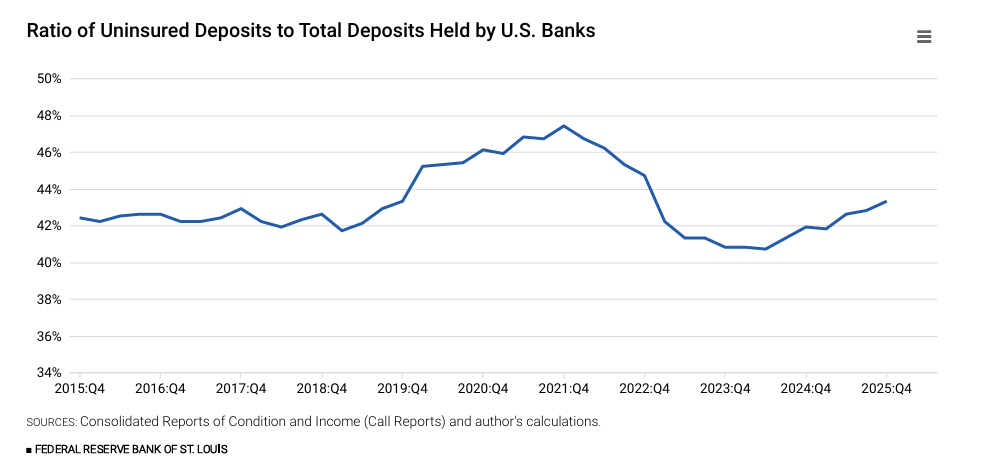
The Federal Deposit Insurance Corp. (FDIC) protects customers against the loss of their insured deposits in the event of a failure of a depository institution whose deposits are insured pursuant to the Federal Deposit Insurance Act. The FDIC fully insures up to the standard maximum deposit insurance amount ($250,000, as of this writing) per depositor, per FDIC-insured bank, per legal ownership category.1
For most retail depositors, FDIC insurance fully insures funds held in their deposit accounts. However, many businesses and other large organizations may hold deposits in excess of the standard maximum deposit insurance amount at a single bank. These funds, called uninsured deposits, are typically held by businesses, nonprofits and high-net-worth individuals. Most banks have some of these uninsured deposits, although larger banks are more likely to have higher proportions of uninsured deposits than smaller banks. Uninsured deposits—like insured deposits—support loan growth and generate fee income. However, uninsured deposits are considered less stable than insured deposits, as depositors have a strong incentive to withdraw their funds if they suspect their bank is in financial trouble.
The proportion of bank deposits that are uninsured has varied over time since the FDIC introduced deposit insurance in 1934. Economic cycles and changes in deposit insurance limits account for most of the variation; the FDIC has raised the maximum deposit coverage seven times since its inception.
Note
Visit this FDIC webpage for details about deposit insurance.