

U.S. banks added $65 billion in Treasury securities to their balance sheets in the first quarter of 2026, bringing total holdings to $1.8 trillion and up from approximately $700 billion just prior to the COVID-19 pandemic.1
Treasury holdings now make up about 5.5% of U.S. bank assets, up from 3% before the pandemic. Bank investment in U.S. Treasuries expanded rapidly during the pandemic as stimulus funds entered the banking system. As illustrated in the figure below, the proportion of bank assets concentrated in Treasuries increased rapidly, then declined, before leveling out over the past few years.
Interest rates, loan demand, deposit growth and bank regulation are some of the factors that influence banks’ willingness to invest in Treasuries. Additionally, these low-risk securities carry a zero percent risk-weight under risk-based capital rules,2 enabling larger holdings without requiring banks to hold additional capital. In 2020, when deposits surged (due to pandemic-era stimulus) and loan growth lagged, banks invested heavily in Treasuries, capitalizing on their favorable capital treatment and liquidity benefits.
Large Banks Drive Treasuries Uptick
While banks of all sizes have increased their Treasury holdings, the trend is most pronounced among the largest institutions, specifically, at global systemically important banks (GSIBs), which held 7.5% of their assets in Treasuries as of March 31, 2026.
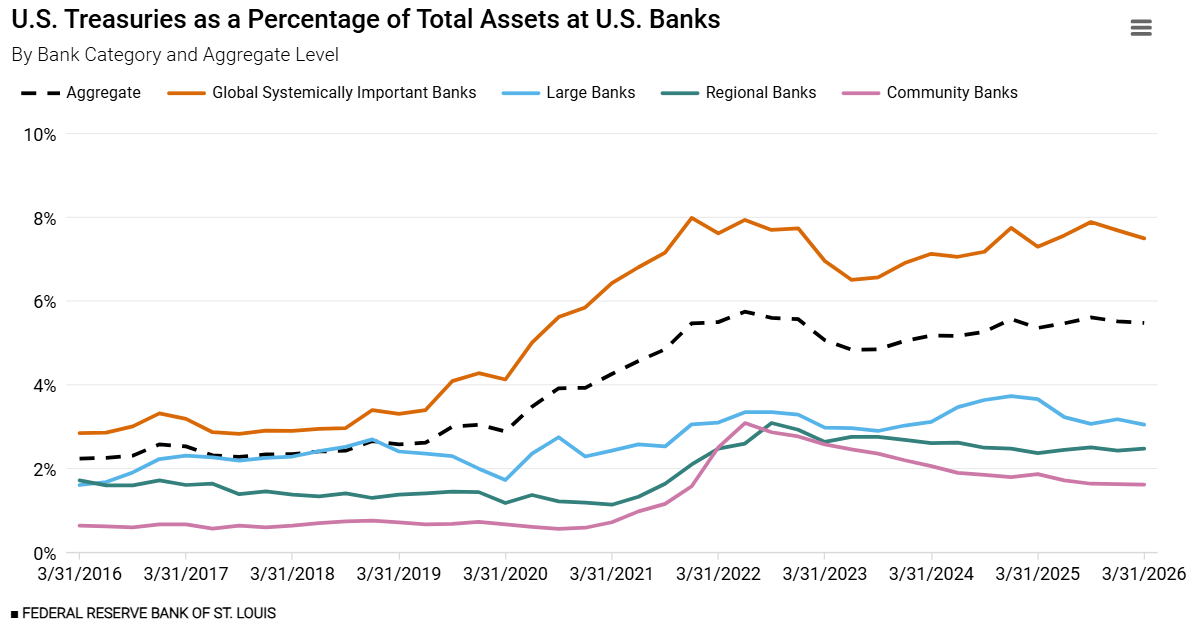
SOURCES: Consolidated Reports of Condition and Income (Call Reports) and author’s calculations.
NOTES: Community banks are those with less than $10 billion in total assets, and regional banks are those with assets between $10 billion and $100 billion. Large banks are those with greater than $100 billion in assets. Global systemically important banks are a small group of financial institutions with such significant economic weight that their failure could trigger global financial instability; the eight U.S. GSIBs held approximately 55% of total U.S. banking system assets as of March 31, 2026.
Among GSIBs, the initial surge in Treasury holdings coincided with a pandemic-related regulatory exemption implemented in April 2020, which temporarily excluded Treasuries from the supplementary leverage ratio calculation,3 a non-risk-based capital requirement applicable only to this group of banks. While some run-off of these securities initially occurred, GSIBs have again been expanding their Treasury holdings in recent years and now hold more than $1.3 trillion in available-for-sale and held-to-maturity Treasury securities.4
Among community banks, Treasury holdings as a percentage of assets have declined from their April 2022 peak. Nevertheless, community banks continue to maintain Treasury portfolios above prepandemic levels, reflecting a lasting shift in balance sheet composition.
Notes
1. U.S. Treasury securities are debt instruments issued by the U.S. Department of the Treasury to fund government operations. They are backed by the “full faith and credit” of the U.S. government, which is generally associated with low default risk. As such, they typically yield lower returns than other securities that may carry higher default risk.
2. Risk-based capital requirements utilize risk-weighted assets to determine how much capital is required to be held based on the riskiness of the bank’s assets, with risk weights ranging from zero percent (U.S. Treasuries) to 1,250% (certain securitizations) depending on the type of asset.
3. The supplementary leverage ratio (SLR) is a Basel III regulatory requirement that large banks hold a minimum amount of Tier 1 capital against their total unweighted assets, including off-balance-sheet exposures. The SLR treats all assets as equally risky.
4. Available-for-sale and held-to-maturity are accounting classifications for securities held on balance sheets. When a bank has the positive intent and ability to hold an investment security until maturity, it is classified as held to maturity. Conversely, securities the bank may retain for long periods but that also may be sold are classified as available for sale.