

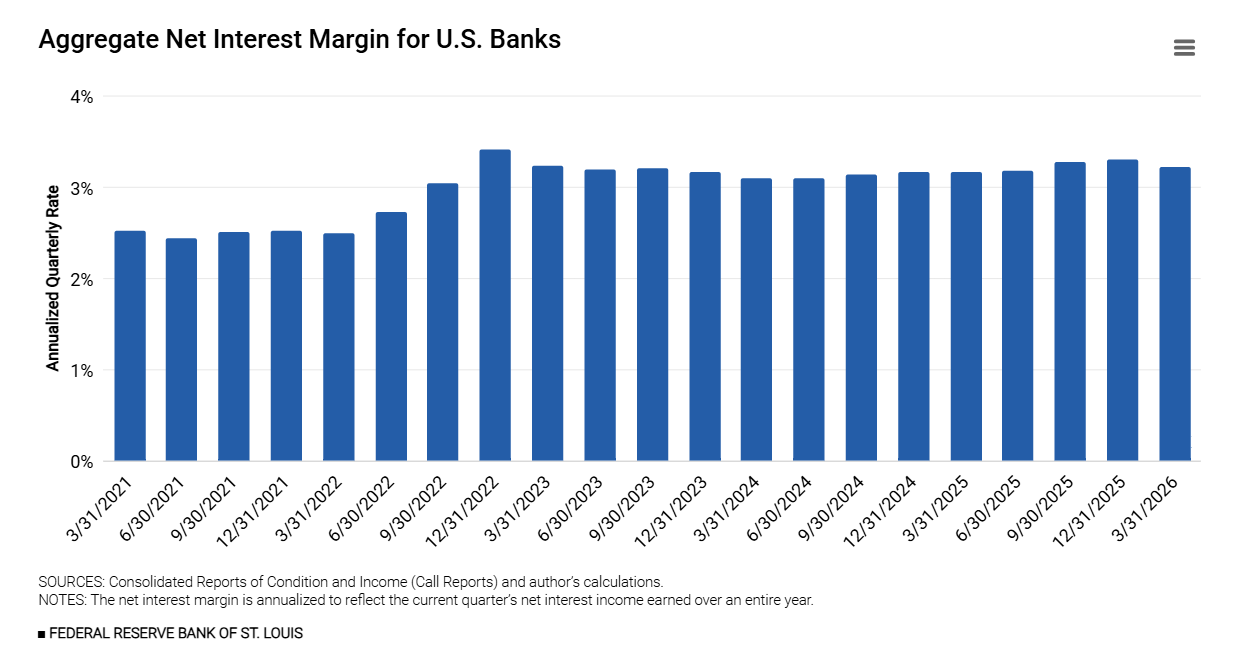
The net interest margin (NIM) of the banking industry contracted in the first quarter of 2026 to 3.22%, down from 3.30% in the fourth quarter of 2025, because of declining asset yields. Nevertheless, NIMs remain robust when compared with the levels seen in 2021 and early 2022, buoyed by a favorable interest-rate environment and healthy loan demand.
The Components of Net Interest Margin
NIM reflects the income earned on a bank’s interest-generating assets, less interest paid on funding sources, its “net interest income,” expressed as a percentage of earning assets.1
In the first quarter of 2026, the banking system experienced its first quarterly decline in net interest income since mid- 2024. This occurred as total interest income fell for the second quarter in a row on declining yields earned on the various assets held by banks, including loans, securities and cash-like instruments. Loan yields, which have been declining for several quarters, for instance, fell from 6.75% to 6.51% in the quarter after peaking at 7.13% in late 2024. Until recently, net interest income had been growing throughout 2024 and 2025 as funding costs, especially interest paid on deposits, declined. This caused overall net interest margins to improve until the most recent quarter, as shown in the figure below.
Meanwhile, earning assets held by banks grew by 1.7% in the quarter, from $23.5 trillion to $23.9 trillion on robust growth in trading assets, loans and interest-bearing cash balances. Earning assets have increased for 10 consecutive quarters as banks expanded lending and trading account activity. While balance sheet growth is generally positive for banks, growth in lower yielding assets can put downward pressure on NIMs.
Factors that may be impacting NIMs are falling interest rates, changes in the mix of the balance sheet, and competition. Loan yields, specifically, will normally decline with falling interest rates, increasing competition among lenders, refinancing activity, shifts in loan mix, payoffs in higher-yielding assets, and changes in the economic landscape.
Note
- Net interest income reflects the difference between a bank’s interest income and interest expense. Earning assets are assets held by banks that generate interest income, such as loans, investment securities, federal funds sold, reverse repurchase agreements and trading assets.