

From 2020 to 2025, the number of U.S. banks declined by 13% while average asset size per institution grew 33% to $5.8 billion.
Since the COVID-19 pandemic, the number of U.S. banks continued its steady decline while average assets per institution rose, reflecting consolidation, limited new bank creation and continued balance-sheet growth among surviving institutions. This analysis examines the 2020-2025 period, but both industry consolidation and reduced de novo bank formation are long-term trends that have been underway for decades. For context, there were more than 14,000 FDIC-insured institutions during the early to mid-1980s.
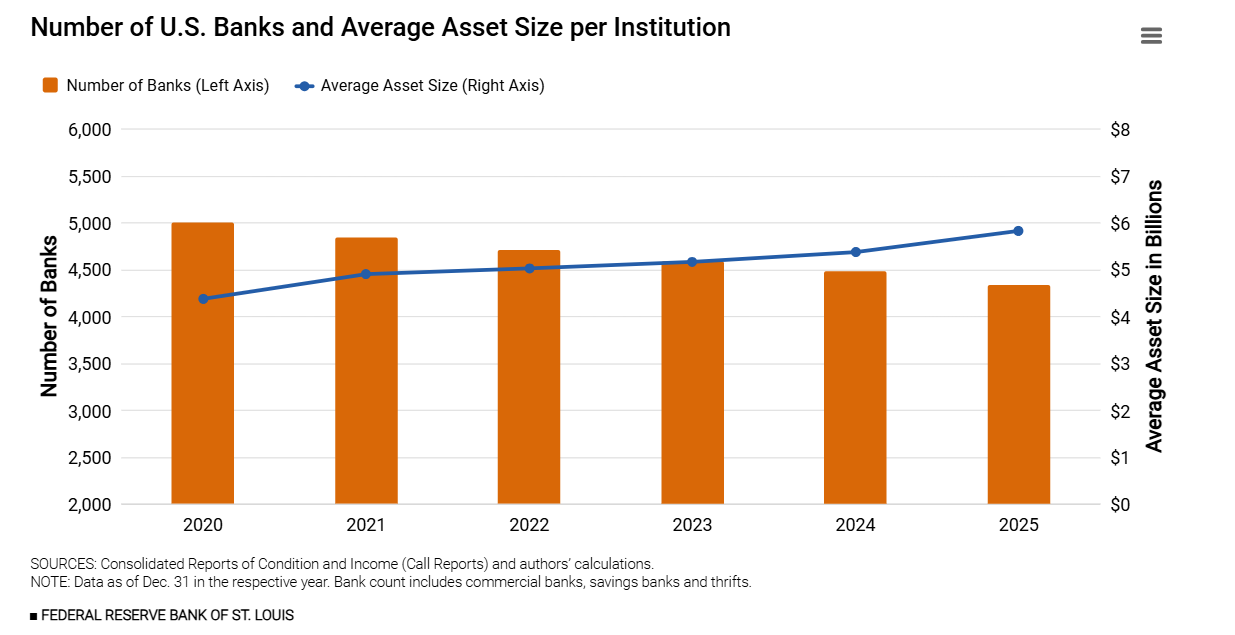
Bank Population Ebbs
The number of banks in the U.S. has continued to fall as bank merger activity outpaced the number of new banks created, also known as de novo formation. When one bank acquires another, the industry loses an individually chartered institution. But the acquired bank’s loans, deposits and other assets typically are transferred to the surviving bank’s balance sheet.
Meanwhile, few de novo banks have formed compared with earlier decades, so the number of new banks entering the industry has not been able to offset increased consolidation. The result is a smaller number of banks controlling a larger pool of assets.1
Asset Growth Swells
Essentially, a bank’s assets represent the economic value of everything it owns, including loans, securities, cash and physical property. Therefore, assets serve as a crucial indicator of a bank's market position and financial strength.
Average asset size rose 15% from $4.4 billion in 2020 to $5 billion in 2022. During that time, there was a surge in core deposits, thanks in part to pandemic-era stimulus funds entering the banking system. Banks used these funds to grow their balance sheets, either through higher cash balances, loan growth or investment securities purchases.
When pandemic-era funding slowed, so did the pace of asset growth until 2025, when increased lending helped give bank balance sheets a boost.2
Indeed, in its Quarterly Banking Profile for the fourth quarter of 2025, the Federal Deposit Insurance Corp. noted the annual rate of loan growth in the fourth quarter of 2025 accelerated to 5.9%, the fastest annual growth rate in 11 quarters, propelled by lending to nondepository financial institutions and credit card loans.
Notes
1. For example, per the FDIC’s Quarterly Banking Profile reports for the fourth quarter of previous years, there were a total of 46 new charters/newly reporting banks during the six-year time period of 2020-2025, an average of nearly eight per year. In comparison, during the six-year time frame of 2002-2007, there were a total of 892 newly reporting banks, an average of 149 per year.
2. For more information, see the Jan. 22, 2026, On the Economy blog post, “Banking Analytics: Core Deposit Growth Accelerated in 2025.”